> ## Documentation Index
> Fetch the complete documentation index at: https://docs.openmic.ai/llms.txt
> Use this file to discover all available pages before exploring further.
# Pre-Tool Webhooks
> Dynamically configure tool behavior and inject real-time data before specific tools execute.
**Dynamic Tool Configuration**: Pre-tool webhooks allow you to fetch
contextual data and customize tool parameters in real-time before specific
tools are executed during calls.
## Overview
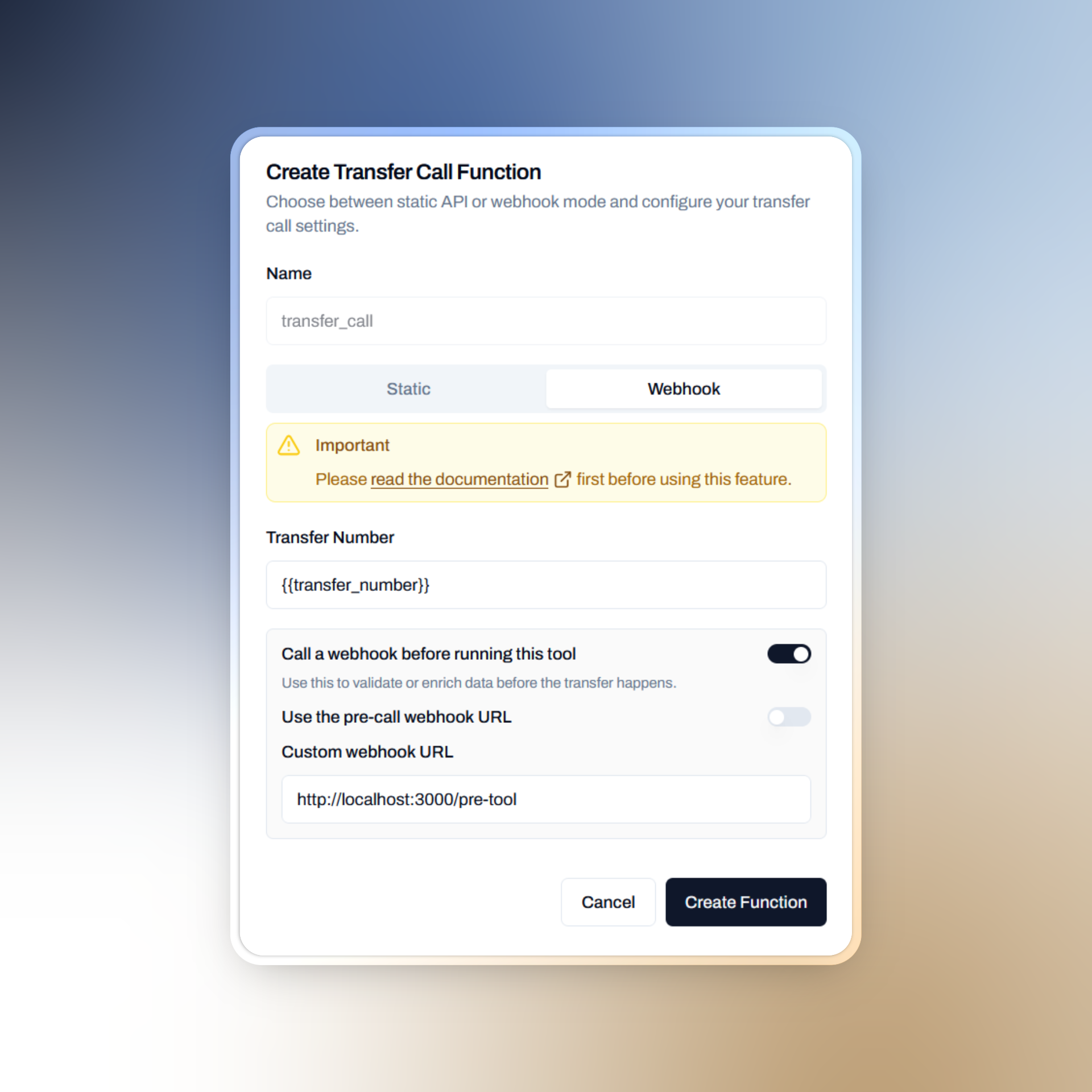 Pre-tool webhooks enable targeted data injection for specific tools during active calls. When certain tools are about to execute, Openmic can optionally send tool details to your webhook endpoint, and your system responds with dynamic variables that customize the tool's behavior.
Fetch relevant information and parameters specific to the tool being
executed.
Modify tool parameters dynamically based on call context and external
data sources.
***
## Configuration Options
### Webhook URL Selection
Pre-tool webhooks support flexible URL configuration:
To reuse your existing pre-call webhook endpoint
{" "}
Specify a dedicated URL for a tool-specific webhook endpoint
Pre-tool webhooks are tool-specific and must be enabled individually for
each tool through the configuration.
***
## Request Specification
### HTTP Method and Timeout
Openmic sends a `POST` request to your configured webhook URL with:
* **Content-Type**: `application/json`
* **Timeout**: 3 seconds per attempt
* **User-Agent**: `Openmic-Webhook/1.0`
Unlike pre-call webhooks, pre-tool webhook failures do not terminate the
call. Tools will execute with original parameters if the webhook fails.
### Request Payload
```json theme={null}
{
"event": "tool",
"tool_name": "calendar_booking",
"tool": {
"direction": "inbound",
"bot_id": "cmdx5w8oc0005q671s3cbg063",
"from_number": "+16167948654",
"to_number": "+916297653534",
}
}
```
### Payload Fields
| Field | Type | Required | Description |
| ------------------ | ------ | -------- | ------------------------------------------- |
| `event` | string | Yes | Always `"tool"` for pre-tool webhooks |
| `tool_name` | string | Yes | Name of the tool being executed |
| `tool.direction` | string | Yes | Call direction: `"inbound"` or `"outbound"` |
| `tool.bot_id` | string | Yes | Unique identifier for the bot/session |
| `tool.from_number` | string | Yes | Caller's phone number in E.164 format |
| `tool.to_number` | string | Yes | Callee's phone number in E.164 format |
### Tool Names
* `calendar_check`
* `calendar_booking`
* `transfer_call`
***
## Expected Response
### Success Response
Your webhook must return a `200` status code with a JSON response containing dynamic variables:
```json theme={null}
{
"tool": {
"dynamic_variables": {
"transfer_number": "+15551234567",
"booking_preference": "morning",
"calendar_timezone": "America/New_York",
"priority_level": "high"
}
}
}
```
### Response Structure
| Field | Type | Required | Description |
| ------------------------ | ------ | -------- | ---------------------------------------------------- |
| `tool` | object | Yes | Container for tool-related data |
| `tool.dynamic_variables` | object | Yes | Key-value pairs of variables to inject into the tool |
**Variable Merging**: Pre-tool dynamic variables are merged with existing
call variables, with pre-tool variables taking precedence for conflicts.
***
## Retry Logic and Error Handling
### Retry Configuration
**3 total attempts** 1 initial request + 2 retries
**3 seconds** Per individual request attempt
**Exponential delays** 1s, 2s, 3s between retries
### Retry Triggers
Openmic retries your webhook in these scenarios:
* **Timeout**: No response within 3 seconds
* **HTTP Errors**: 4xx or 5xx status codes
* **Network Errors**: Connection failures or DNS resolution issues
* **Invalid JSON**: Malformed response body
### Failure Handling
**Graceful Degradation**: If all webhook attempts fail, the tool will
execute using its original parameters without dynamic variables.
Pre-tool webhooks are designed for graceful degradation. When webhook calls fail:
1. The failure is logged for debugging purposes
2. The tool continues execution with its original static parameters
3. Any existing call-level dynamic variables remain available
4. The call continues normally without interruption
***
## Examples
```js theme={null}
// Example transfer number lookup function
async function getTransferNumber(fromNumber) {
// Pretend we're fetching from a transfer number lookup API
console.log(`Looking up transfer number for: ${fromNumber}`);
return {
transfer_number: '+1234567890' // match variable name from docs
};
}
app.post('/webhook/pre-tool', async (req, res) => {
const { tool_name, tool } = req.body;
console.log(`🔧 Pre-tool webhook for: ${tool_name}`, tool);
try {
if (tool_name === 'transfer_call') {
const transferNumber = await getTransferNumber(tool.from_number);
return res.json({
tool: {
dynamic_variables: transferNumber
}
});
}
// Default: no customization for other tools
return res.json({
tool: {
dynamic_variables: {}
}
});
} catch (err) {
console.error('❌ Failed to fetch tool data', err);
// Graceful degradation: return empty vars if lookup fails
return res.json({
tool: {
dynamic_variables: {}
}
});
}
});
```
Pre-tool webhooks enable targeted data injection for specific tools during active calls. When certain tools are about to execute, Openmic can optionally send tool details to your webhook endpoint, and your system responds with dynamic variables that customize the tool's behavior.
Fetch relevant information and parameters specific to the tool being
executed.
Modify tool parameters dynamically based on call context and external
data sources.
***
## Configuration Options
### Webhook URL Selection
Pre-tool webhooks support flexible URL configuration:
To reuse your existing pre-call webhook endpoint
{" "}
Specify a dedicated URL for a tool-specific webhook endpoint
Pre-tool webhooks are tool-specific and must be enabled individually for
each tool through the configuration.
***
## Request Specification
### HTTP Method and Timeout
Openmic sends a `POST` request to your configured webhook URL with:
* **Content-Type**: `application/json`
* **Timeout**: 3 seconds per attempt
* **User-Agent**: `Openmic-Webhook/1.0`
Unlike pre-call webhooks, pre-tool webhook failures do not terminate the
call. Tools will execute with original parameters if the webhook fails.
### Request Payload
```json theme={null}
{
"event": "tool",
"tool_name": "calendar_booking",
"tool": {
"direction": "inbound",
"bot_id": "cmdx5w8oc0005q671s3cbg063",
"from_number": "+16167948654",
"to_number": "+916297653534",
}
}
```
### Payload Fields
| Field | Type | Required | Description |
| ------------------ | ------ | -------- | ------------------------------------------- |
| `event` | string | Yes | Always `"tool"` for pre-tool webhooks |
| `tool_name` | string | Yes | Name of the tool being executed |
| `tool.direction` | string | Yes | Call direction: `"inbound"` or `"outbound"` |
| `tool.bot_id` | string | Yes | Unique identifier for the bot/session |
| `tool.from_number` | string | Yes | Caller's phone number in E.164 format |
| `tool.to_number` | string | Yes | Callee's phone number in E.164 format |
### Tool Names
* `calendar_check`
* `calendar_booking`
* `transfer_call`
***
## Expected Response
### Success Response
Your webhook must return a `200` status code with a JSON response containing dynamic variables:
```json theme={null}
{
"tool": {
"dynamic_variables": {
"transfer_number": "+15551234567",
"booking_preference": "morning",
"calendar_timezone": "America/New_York",
"priority_level": "high"
}
}
}
```
### Response Structure
| Field | Type | Required | Description |
| ------------------------ | ------ | -------- | ---------------------------------------------------- |
| `tool` | object | Yes | Container for tool-related data |
| `tool.dynamic_variables` | object | Yes | Key-value pairs of variables to inject into the tool |
**Variable Merging**: Pre-tool dynamic variables are merged with existing
call variables, with pre-tool variables taking precedence for conflicts.
***
## Retry Logic and Error Handling
### Retry Configuration
**3 total attempts** 1 initial request + 2 retries
**3 seconds** Per individual request attempt
**Exponential delays** 1s, 2s, 3s between retries
### Retry Triggers
Openmic retries your webhook in these scenarios:
* **Timeout**: No response within 3 seconds
* **HTTP Errors**: 4xx or 5xx status codes
* **Network Errors**: Connection failures or DNS resolution issues
* **Invalid JSON**: Malformed response body
### Failure Handling
**Graceful Degradation**: If all webhook attempts fail, the tool will
execute using its original parameters without dynamic variables.
Pre-tool webhooks are designed for graceful degradation. When webhook calls fail:
1. The failure is logged for debugging purposes
2. The tool continues execution with its original static parameters
3. Any existing call-level dynamic variables remain available
4. The call continues normally without interruption
***
## Examples
```js theme={null}
// Example transfer number lookup function
async function getTransferNumber(fromNumber) {
// Pretend we're fetching from a transfer number lookup API
console.log(`Looking up transfer number for: ${fromNumber}`);
return {
transfer_number: '+1234567890' // match variable name from docs
};
}
app.post('/webhook/pre-tool', async (req, res) => {
const { tool_name, tool } = req.body;
console.log(`🔧 Pre-tool webhook for: ${tool_name}`, tool);
try {
if (tool_name === 'transfer_call') {
const transferNumber = await getTransferNumber(tool.from_number);
return res.json({
tool: {
dynamic_variables: transferNumber
}
});
}
// Default: no customization for other tools
return res.json({
tool: {
dynamic_variables: {}
}
});
} catch (err) {
console.error('❌ Failed to fetch tool data', err);
// Graceful degradation: return empty vars if lookup fails
return res.json({
tool: {
dynamic_variables: {}
}
});
}
});
```